
What Candler County Deed Records Convey
The Clerk of Superior Court records instruments affecting Candler County land, and GSCCCA supplies the statewide online index. A label only hints at role. Always read the instrument's label alongside its full text. A deed transfers whatever interest its terms state, while a security deed, lien, release, easement, judgment, or plat plays a different part even when indexed side by side.
| Deed Type | What It Does | Common Use |
|---|---|---|
| Warranty deed | Conveys the stated interest with deed covenants | Ordinary sale transfers |
| Quitclaim deed | Conveys the grantor's interest without promising its extent | Family or title-cleanup transfers |
| Executor or administrator deed | Conveys property through authorized estate administration | Probate-related transfers |
| Tax deed | Records a transfer arising from a completed tax-sale process | Delinquent-tax conveyances |
| Security deed | Secures an obligation and is not a sale deed | Georgia real-estate financing |
A tax delinquency, FIFA, levy, advertisement, redemption, and tax deed are separate events in Candler County deed records. One step never proves a completed transfer. A lien or security deed can burden title without conveying the owner of record's full interest.
Candler Deed Search Fields on GSCCCA
The GSCCCA name-search page works by party, not by address. Candler researchers use the portal's name convention for individuals. Entities need their exact legal name, and an uncertain chain may justify repeating the query in another party role.
| Search control | Title-chain use | Research limit |
|---|---|---|
| Party Type | Separate transferor and recipient roles | Dropdown options were not exposed |
| Instrument Type | Focus on a deed or related filing | Full list was not captured |
| County | Select Candler | Neighboring-county expansion is optional |
| Search Name | Find individual or entity index entries | Spelling and indexing still matter |
| Date range | Limit the recording period | Specific Candler good-from date must be checked live |
| Display controls | Set rows and table view | They do not expand record coverage |
GSCCCA also supports book-and-page and property routes. The property search needs a subdivision. It also depends on county participation, so confirm Candler appears in the live selector before relying on it. The GSCCCA name-search screen displays the statewide controls used to narrow Candler County deed records by party and recording period.
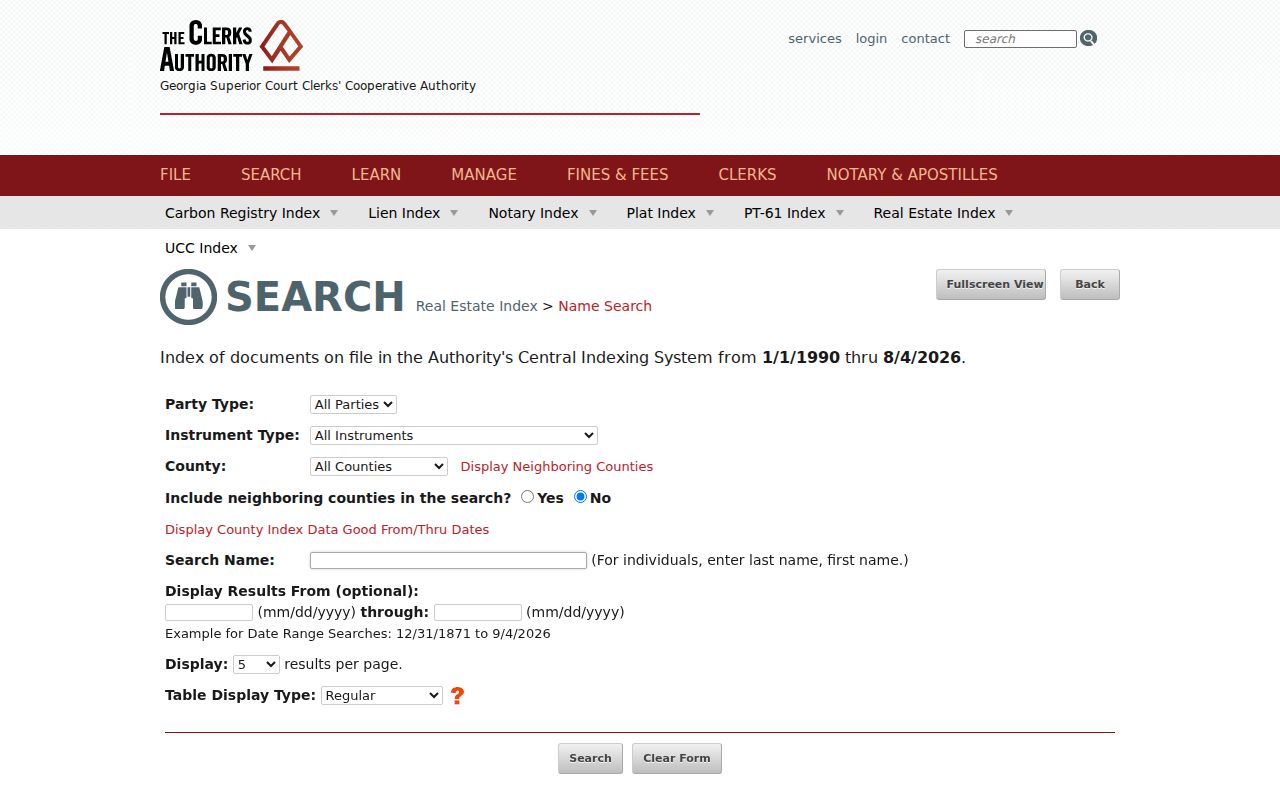
The screen lists the available starting fields. An index row plus its deed image still proves a particular transfer in Candler County.
Book and Page Make a Candler Deed Precise
Start with any citation you already have. A tax card or prior deed often lists one. Enter it in the GSCCCA book-and-page search with Candler selected. Both numbers are required. Formatting must match the portal exactly. That route skips common-name noise and lands on the referenced index entry or deed image when available.
An instrument number is a different recording identifier and never substitutes for book and page. Copy each label as shown. For a boundary question, carry the legal description into the plat index and any attached exhibit rather than relying on the assessor polygon.
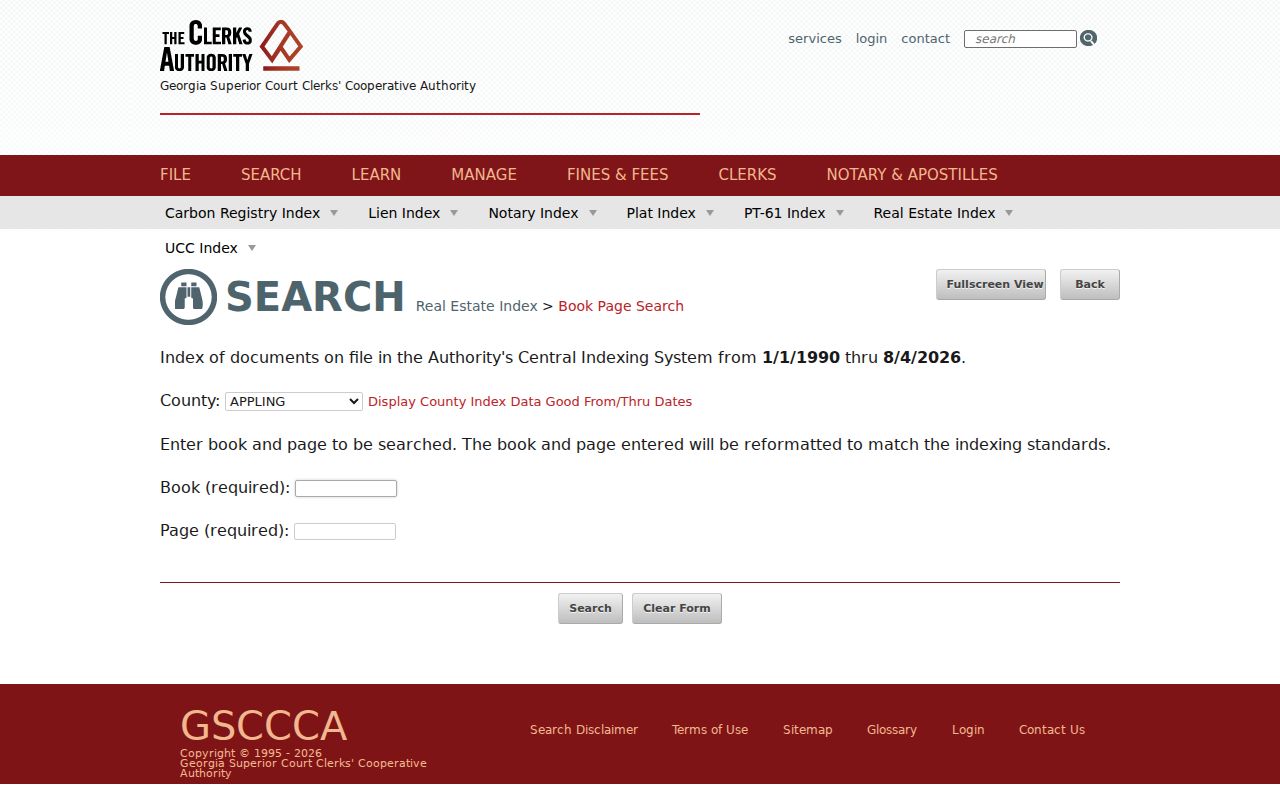
The book-and-page screen's county, book, and page controls beat a broad name query for precision. Keep the source's exact formatting.
Walk the Candler County Grantor-Grantee Chain
Candler deed indexes are built around named parties. Begin with the newest plausible ownership instrument. Confirm its legal description matches the subject parcel. Then move backward through each person or entity that conveyed or acquired the land, using dates, recording references, legal text, and adjoining tracts to rule out same-name false hits.
- Find the current owner's acquisition instrument with that owner as grantee.
- Read the grantor, legal description, recording date, and prior references from the image.
- Search that grantor as an earlier grantee and verify the same land description.
- Repeat while logging every book/page or instrument number and any gap.
- Move to Clerk-held books and predecessor counties when the online index ends.
- Grantor
- The party conveying the stated interest.
- Grantee
- The party receiving the stated interest.
- Chain of title
- The linked sequence of instruments affecting the same land.
- Book/page
- A volume and page reference, distinct from an instrument number.
Candler Online Coverage Has Two Date Stories
GSCCCA's real-property project indexes transactions from all counties beginning January 1, 1999. Historical material from 1993 through 1998 is being added. Yet the name and book-and-page pages show a broader starting year of 1990. Neither statement guarantees a complete Candler County run.
Check the county date display. Use Candler's live good-from and good-through dates, then ask the Clerk about any year or book outside that confirmed range.
Candler County's records tell two different stories about dates. The Georgia Archives points out that its online county-card coverage leans toward counties formed before 1900. Candler came along in 1914. For that reason, the local Clerk's custody matters more here than in older counties, and tracing a deed back far enough may mean checking predecessor counties too. Legal custody and online availability are separate things. A record missing from the portal could simply be old, unscanned, or filed under a different spelling of the name. It might also fall outside the participating data. Before contacting the Clerk, jot down the search name, role, instrument filter, date range, county selection, and access date. A log like that lets staff pull a deed book, local index, or public terminal record without redoing the whole property records search from scratch.
Before 1914, Follow the Land Beyond Candler
Candler County was cut from Bulloch, Emanuel, and Tattnall. Formation did not reset title. It moved the older record. A deed chain predating the county may continue in one of those jurisdictions under older community, road, district, or legal-description terms.
Several sources add context for the earlier era. The Georgia Archives Virtual Vault offers tax collections and research help, FamilySearch catalogs an indexed 1994 Candler and Metter history, and the Candler County Historical Society and L.C. Anderson Memorial Library hold local material. These aids locate names and places. The deed book remains the primary transfer record.
Ask the Clerk which local deed books, reverse indexes, scans, or microfilm cover the missing period. If the land predates the county, test Bulloch, Emanuel, and Tattnall with its legal description and older party names. A street address is weaker there. Road names, numbering, and delivery labels change. The land description persists. That description, not the address, carries the search across county lines.
Plats and Easements Beside Candler Deeds
The GSCCCA Plat Index opens two ways into plat records. One is a name search. The other is a book/page lookup. Candler plats may or may not be included, since participation varies by county. Check the index itself. A plat can carry a lot, block, subdivision name, street rights-of-way, surveyor certification, and approval notes. Metter adds its own wrinkle. The city requires an approved final plat recorded with the Clerk before a building permit issues. One document therefore carries two proof points: municipal approval and county recording.
Read an easement from its recorded instrument and exhibits, not from a map line. A qPublic overlay or the 2025 GDOT county map can orient a search. But neither establishes a legal boundary. For a map-first approach, the Candler County parcel map guide walks through that distinction in detail.
Other instruments sit beside the transfer chain. Security deeds, assignments, cancellations, releases, restrictive covenants, judgments, and tax FIFAs can all shape a deed's meaning. Search each party in both grantor and grantee roles. Pull the recorded image before concluding that an obligation was released. The GSCCCA lien index offers name, book/page, and state pending-lien routes. Each county's submissions determine the results, though.
Candler Filing Alerts Are Forward-Looking
GSCCCA's Filing Activity Notification System, called FANS, is a free voluntary account service. It sends notice after filing activity is indexed under a registered name. The service looks forward only. It is not retroactive. It also cannot guarantee detection of every filing. So treat any alert as a prompt, not a verdict. Inspect the actual filing. Contact the Clerk before drawing conclusions about validity or fraud.
The official FANS page presents the statewide service's account entry point. It shows no Candler deed. It replaces nothing in the county record.
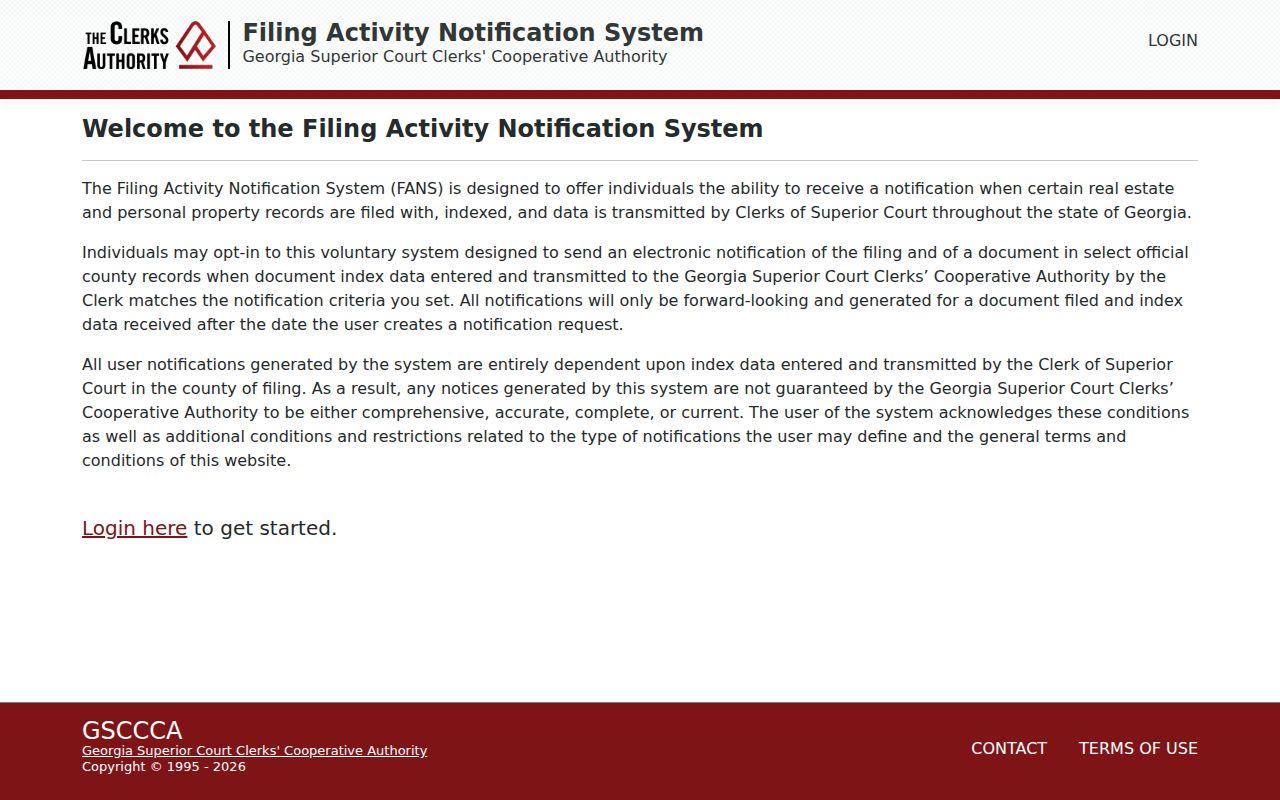
Save the date, indexed name, and recording reference first.
Obtain a Candler County Deed Copy
Start with an online image if GSCCCA provides one. Its research-time terms listed viewing as potentially free, printing at $0.50 per page, $5 single-use access for four hours, and a $14.95 monthly account option. Terms can change, so confirm the current screen before paying. Candler Superior Court also appears among counties available through GSCCCA eCertification.
For the controlling local record, contact the Clerk of Superior Court at 35 SW Broad Street, Metter, GA 30439, or 912-685-5257. Give the parties, record date, document type, and book/page or instrument number. Ask whether a plain copy, certified paper copy, or digital certification fits the purpose, and request the current fee. The Clerk publishes no local copy fee schedule online, so confirm mail and counter availability directly.
If the portal lacks the needed image, use the courthouse counter, telephone, or a narrowly framed request. Ask for an existing deed by its citation rather than asking staff to assemble a title chain. Georgia's open-records process does not require an office to create a new report, and certification concerns the copy's official form rather than whether the instrument conveys clear title.
Recorded, not guaranteed. Candler County deed records show filed instruments, not a title opinion; unrecorded interests and indexing errors can exist.