
Trace Candler County Previous Owners Through Each Transfer
Start the chain with the newest deed. It names the latest grantee. From there, follow each grantor back to the deed by which that same person acquired the tract, matching book and page, dates, instrument type, and the legal description at every step. Names alone prove nothing. A working table with one row per transfer keeps a repeated surname or an unrelated parcel from slipping into the history.
| Transfer Date | Grantor to Grantee | Deed Type | Book/Page |
|---|---|---|---|
| Newest recorded date | Prior owner to present grantee | As indexed and confirmed on image | Copy exact reference |
| Prior recorded date | Earlier owner to that grantor | As recorded | Copy exact reference |
| Next earlier date | Repeat with matched land | As recorded | Copy exact reference |
| Before Candler County | Search predecessor-county parties | Deed or other conveyance | Use predecessor book/page |
The Candler County Clerk of Superior Court holds the official recorded instruments. The GSCCCA Real Estate Search is the statewide discovery route. The clerk's own index and instrument still control. Keeping one row per transfer prevents a shared surname from entering the chain by mistake. It also stops an unrelated parcel from slipping in.
Candler County Former-Owner Coverage Has More Than One Date
GSCCCA describes all-county real-estate transactions from January 1, 1999, with 1993 through 1998 material being added. Its name and book/page indexes claim a broader window. They run January 1, 1990 through August 4, 2026. Neither statement fixes Candler County's good-from date, so the earliest local books remain the safer test.
Coverage check. Do not treat the displayed statewide range as a firm local cutoff; ask the Candler County Clerk about older or missing index entries.
A blank result has three common causes. The name format may be wrong, the record may not be indexed in the web service, or the deed may sit in an older local book. Note the county, role, spelling, dates, and filters. Those details give the clerk's office something concrete to check when you call or visit.
Use Candler County Grantor and Grantee Fields With Care
The GSCCCA name form exposes Party Type, Instrument Type, County, a neighboring-county choice, Search Name, optional date limits, results per page, and display type. The dropdown choices can change. Confirm the role and instrument label on screen. Never assume what a code means, because a wrong party type quietly drops the deed you need from the results.
| Search Control | How It Supports a Backward Chain |
|---|---|
| Party Type | Separate the seller or grantor from the buyer or grantee when the portal permits. |
| Instrument Type | Narrow a broad name result, then verify the exact recorded label. |
| Candler County | Keep the current chain local until the legal history points elsewhere. |
| Search Name | Enter individuals in last-name, first-name form and preserve entity spelling. |
| Date range | Bracket the likely acquisition period without hiding older candidates. |
Book/page search needs a reference. A deed, parcel card, or older instrument usually provides the book and page. That route sidesteps common-name confusion. But it still demands the portal's exact formatting and the correct county.
The official GSCCCA name-search page displays the Candler County controls.
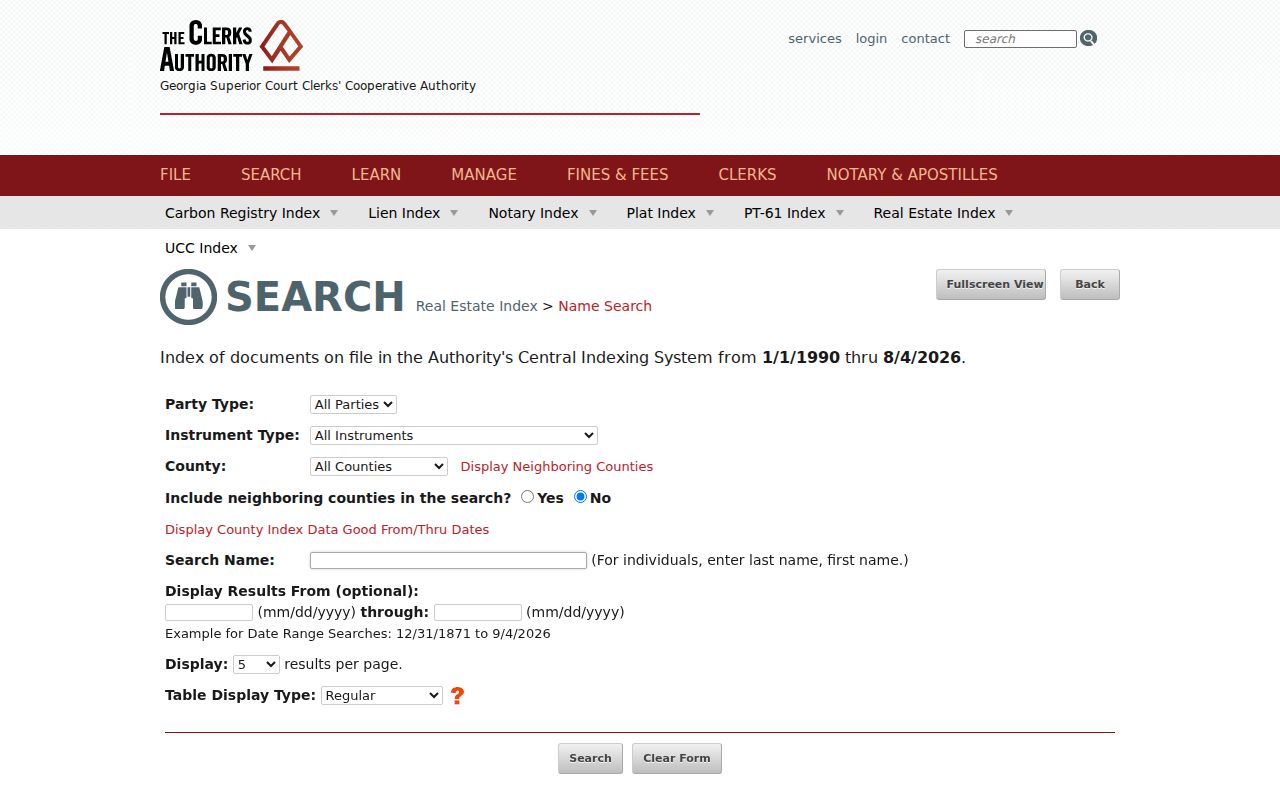
The screen is only an index. The deed image and the local clerk's record still supply the evidence for each transfer.
Walk the Candler County Chain of Title Backward
The work repeats. Prove one transfer, extract the former owner, then find that person's acquisition of the same tract. A current qPublic owner is a lead, not proof, since the newest deed may postdate the assessment roll. No official Candler County update lag has been published.
- Find the latest deed with the present owner or entity as grantee, then open the instrument.
- Copy the grantor, recording date, execution date, legal description, and book/page.
- Search that grantor as an earlier grantee and match the same land, not just the name.
- Repeat until the online index stops, then ask for the relevant deed book or older index.
- Grantor and grantee
- The conveying party and the receiving party named in an instrument.
- Chain of title
- The linked sequence of instruments affecting ownership of the same land.
- Reverse index
- An index organized to help trace parties in the opposite role or direction.
- Warranty and quitclaim deeds
- Different forms of conveyance whose legal effect must be read from the recorded document.
Match Candler County Past Owners to the Same Land
Street addresses change. The legal description is the better link. Compare lot, block, subdivision, land lot, district, metes-and-bounds calls, rights-of-way, acreage, and cited plats across every deed in the chain. A mailing address is not the property situs.
Candler County also enforces road-naming and property-numbering rules, while Metter assigns E-911 addresses. Search SE and Southeast alike. Try Street and St, Highway and Hwy, and every suffix, but use those variants to locate the deed rather than to prove parcel identity.
Recorded Plats Keep Candler County Previous Owners on the Right Lot
The GSCCCA Plat Index is the first stop. It offers name and book/page routes into plat records for participating counties. Check whether Candler County's data appears. A plat ties a deed's lot and block to streets, rights-of-way, approvals, and the owner's certification.
Metter plats follow a set sequence. The final subdivision plat must be recorded with the Clerk after city approval. Building permits are issued only after that. That order separates proposals from recorded lots. A plat still proves less than a deed. The owner chain rests on the instruments themselves.
Estate Records Can Explain a Break Between Candler County Owners
Sometimes a chain of title breaks. Estate papers often explain the gap. A will, administration file, petition to sell, heir consent, guardianship order, or final discharge may show why the next deed carries an estate, fiduciary, or heir name. Candler County Probate Court sits at 35 SW Broad Street in Metter and handles the probate side of the trail.
Probate papers provide authority, not a deed. Identify the personal representative and the court order. Then return to the recorded instruments for the conveyance that implements the transfer. That discipline keeps prior owners in chronological order even when the assessment roll skips an estate stage.
Candler County Ownership Before 1914 Leads to Three Counties
Candler County dates to 1914. It was carved from Bulloch, Emanuel, and Tattnall counties. Land recorded before that year sits in a predecessor's deed books rather than Candler's own. A parcel with deep roots may simply have no earlier Candler deed. Follow the legal description, road names, and community clues into the right parent county's records.
The Georgia Archives research guide warns that its county-card aids lean toward counties formed before 1900. A Candler series may not appear there. Begin instead with the Clerk's deed indexes. From there, Archives microfilm, reproduction services, the FamilySearch catalog, and predecessor-county repositories extend the chain as needed. The Archives handles in-person research and copies. Local context can come from the Candler County Historical Society museum and the L.C. Anderson Memorial Library once their holdings are confirmed. The earliest surviving Candler deed book and reel number remain unlisted in any public source.
Legacy Candler County Map Clues Support Former-Owner Research
Board of Assessors minutes from 2020 describe old paper maps drawn at a 660 scale. The sheets measured 28 by 24. Parcels sharing a first three digits were grouped together. One minute notes that an old CD number no longer applies. Treat these as records-room clues only. They are not a current parcel-number formula.
Use a legacy map reference to point you toward the next official source. Then confirm the modern parcel ID in qPublic. Reconcile it against the deed's legal description, any plat reference, and the book-and-page trail.
How Far Back Candler County Previous-Owner Records Reach
Candler County records have no single online cutoff that covers every instrument. The date statements GSCCCA displays differ from one record set to another, and older deeds often still sit in local books at the courthouse. For land from before 1914, the trail leads into the predecessor counties that once held that territory. The best stopping point is a documentary one. Stop at the last deed where the legal description and the recording reference both match, and note which older index or repository holds the next step.
Lawful use. Research past owners for house history and property diligence. Never use a deed chain to track, threaten, or harass a living person.
Need a certified instrument, title proof, or help with a disputed gap? Contact the Candler County Clerk of Superior Court at 35 SW Broad Street in Metter, or call 912-685-5257. Request the index, deed book, or recorded image using the facts already gathered.