
What Candler County Property Tax Records Contain
The Board of Assessors decides value. It determines fair market and assessed values and administers every exemption in the county. The Tax Commissioner handles bills. That office issues and collects payments, works delinquency, and publishes tax-sale information, while Georgia generally assesses property at 40 percent of fair market value, with exemptions and special programs able to change the taxable amount.
| Field | What It Shows | Where |
|---|---|---|
| Fair market value | The assessor's estimate of full value | Board of Assessors |
| Assessed value | Normally 40 percent of fair market value | Board of Assessors |
| Exemptions | Approved reductions or special treatment | Board of Assessors |
| Tax bill and status | Charged amount, balance, and payment state | Tax Commissioner |
| Millage | The levy applied to taxable value | Adopted tax material and bill |
Neither figure is the recorded sale price. Neither is a private appraisal, so compare Candler County property tax records only across the same year, parcel, exemption status, and jurisdiction.
Two Candler Offices, Two Tax Jobs
The Board of Assessors is at 25 W Daniel Street, Suite B, Metter, with telephone 912-685-6346 and published weekday hours from 8:00 a.m. to 5:00 p.m. It values property as of January 1, reviews returns, manages exemptions, and handles assessment questions. The Tax Commissioner is in Suite A, at 912-685-5247, with published weekday hours from 8:30 a.m. to 5:00 p.m.
Questions about fair market value, assessed value, classification, or an exemption belong with the assessor. Questions about an issued balance, payment, delinquency, or tax sale belong with the Tax Commissioner. Keeping that split clear saves time and prevents a billing record from being mistaken for a valuation decision.
Candler qPublic Tax Search Routes
The assessor links straight to Candler qPublic. Use it for parcel and owner lookups. If the live form will not load, the office can run the same property search for you over the phone.
| Route | Tax use | Known limit |
|---|---|---|
| Owner Name | Find accounts under a person or entity | Exact-match control not live-verified |
| Location Address | Open the assessment card for a situs | Range behavior not captured |
| Parcel Number | Match the precise assessment account | Local format not published |
| Legal Information | Search land-description terms | Syntax not captured |
A county sample card shows owner mail, property location, parcel and alternate-ID fields, valuation, and sale-history entries. It is a sample, not a live account. Candler publishes no schedule for refreshing the tax roll. The assessor landing page is the official doorway to Search Records, forms, exemptions, and appeal material. If the application stays down, call the office. Give the staff the owner name, situs, parcel identifier, and tax year, and request the existing assessment record directly.
Trace a Candler County Tax Bill
The GovernmentWindow entry point supplies the Search and Pay Taxes route. Start with a parcel number from qPublic. Verify the tax year and parcel, then read the balance.
- Find the parcel and assessment year through qPublic or the assessor.
- Search the Tax Commissioner gateway with the available live controls.
- Verify owner, parcel, year, billed amount, and payment state.
- Compare the assessment and exemptions for that same year.
- Confirm each delinquency, FIFA, levy, sale, or redemption stage separately.
- Assessed value
- The statutory portion of fair market value used in the calculation.
- Mill
- One dollar of tax per one thousand dollars of taxable value.
- Homestead exemption
- Approved relief tied to a qualifying primary residence.
- Tax FIFA
- A recorded execution tied to unpaid tax, not a completed sale.
Candler Homestead and Current-Use Records
Georgia's homestead guidance sets April 1 as the general deadline. Applications go through the county tax office. Confirm Candler's exact eligibility, documents, and the exemption shown on the parcel with the assessor. Never infer one from age, name, or land use. Agriculture and timber shape Candler's tax roll. Current-use and conservation programs can explain a taxable figure that looks low beside the acreage. The proof sits in documents. The assessment card and any recorded covenant must establish participation, not the look of the land. A manufactured home adds more paths. Land deed, permit, decal, personal-property, and zoning records can each apply, so check every applicable family. County material describes these programs with ten-year covenants. A low taxable figure deserves confirmation on the assessment record, plus any underlying covenant or qualifying filing. The Georgia Department of Revenue homestead guidance covers statewide eligibility and timing, while the Candler assessor controls the local application record.
Candler Delinquency Records Mark Different Stages
County tax information lays out the stages of delinquency. Notice comes first, then a possible FIFA, added charges, advertising, certified notice, levy work, and a potential sale. The portal carries Tax Sales navigation too. An unpaid bill does not prove a recorded execution, and an advertised sale does not prove a deed was issued.
| Stage | Confirm with | Do not infer |
|---|---|---|
| Unpaid bill | Tax Commissioner account | Sale or title transfer |
| Tax FIFA | Clerk docket and tax office | Loss of ownership |
| Levy or advertisement | Tax office, sheriff, published notice | Completed conveyance |
| Sale or redemption | Official sale file and recorded deed | Clear title |
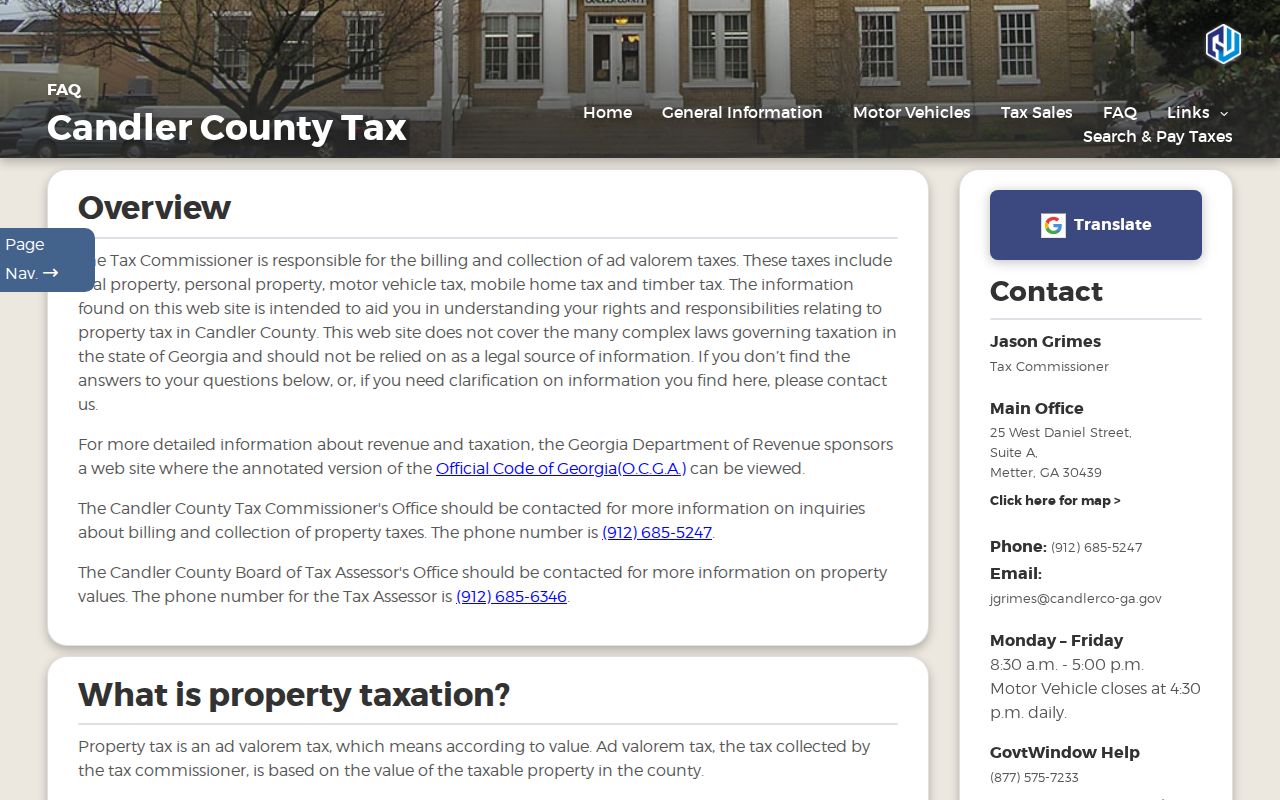
Candler's own pages give conflicting due-date and charge descriptions. Rely on the current bill, the mailed notice, and the adopted millage for the live year. The Candler tax FAQ separates assessment from collection. Date-sensitive charges still need checking against the current account before you rely on them.
Note: The image is reference material only, not a live bill or proof that a tax account stands delinquent.
The Proposed 2026 Candler Millage
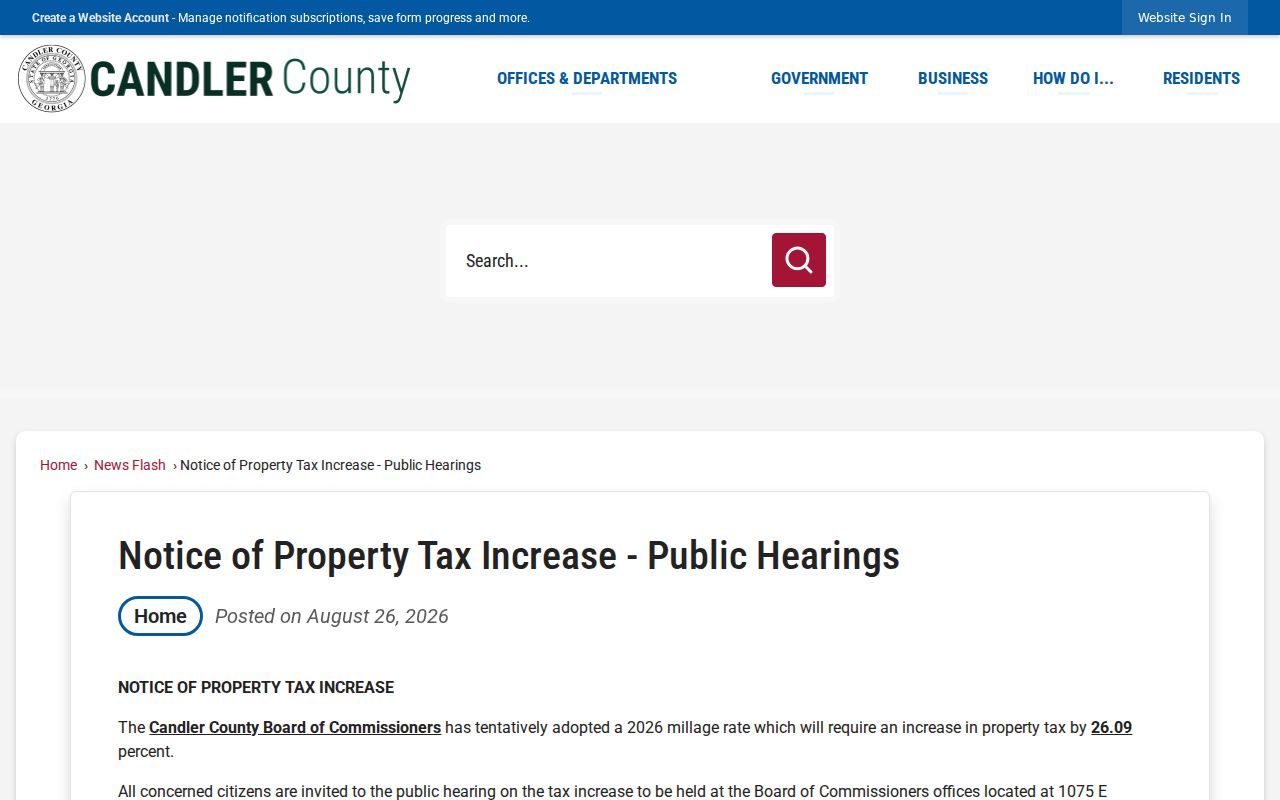
The notice proposed 13.294 mills. Posted August 26, 2026, it listed hearings on September 9 and September 21, 2026. A proposal is not the final rate. The county millage notice preserves that time-specific context, and the final adopted rate, once set, is what the bill should print.
Use current notices and Department of Revenue millage tables.
Contest a Candler County Assessment on Time
Georgia allows 45 days from the assessment notice date to appeal. The clock does not wait. Use the PT-311A, the uniform state form. Submit it to the Candler County Board of Tax Assessors. Keep proof of delivery. Bring evidence such as the notice, parcel card, corrected property facts, comparable sales, photographs, or a survey tied to the valuation date.
Appeal window. A Candler County assessment appeal must reach the Board of Tax Assessors within 45 days of the notice date.
Request Candler Tax Records Directly
When a portal lookup stalls, call the office. Each custodian can hand you an existing record. The assessor furnishes parcel cards, assessment notices, exemption records, maps, and returns for a named parcel and year. The Tax Commissioner answers for the bill, the payment ledger, any delinquency, and the tax-sale file. Requests go through the county's open-records routing, which lands them with the office that actually holds the paper.
Be specific. Give the parcel number, situs, indexed owner name, tax year, and the exact document sought. Georgia agencies do not build new analyses. Several narrow requests for existing documents work far better than one plea to reconcile the whole chain.
Phone, mail, and counter service also sidestep portal failures. Ask whether staff can mail a plain copy of a bill, payment history, delinquency notice, or sale-file document. Request the current copy charge before ordering. Send valuation requests to the assessor instead. The Board of Commissioners' general open-records page routes tax and assessment records back to their real custodians.
Reconcile Candler Tax Values After a Transfer
A sale can show up in the Clerk's recording index before the assessment roll carries the new owner of record. The tax account may still follow a prior billing cycle. Candler County publishes no official closing-to-roll lag. Write down the deed recording date. Note the owner and sale date on the parcel card, the assessment year, and the tax bill year. That timeline beats assuming one source is wrong.
Sale price is a separate number too. A deed or transfer field may state consideration. qPublic may list a sales-history entry, and the assessor reports fair market and assessed values. The county sample card shows FM and Q codes, though the assessor publishes no official legend for them. Leave those initials unexpanded until the assessor supplies the code meaning. For a fuller explanation of the numbers, see the Candler County property value guide.
Other events can pull records apart as well. Estate administration, divorce, foreclosure, an entity-name change, or a conservation covenant can each leave a different record. Each record tells a different part of the story. Match legal descriptions and parcel identifiers first, then ask each custodian about its own record date. The Tax Commissioner can confirm the account and payment state. The assessor can explain the roll, and the Clerk can supply the latest recorded instrument.
January 1 is the key Georgia valuation date the Candler assessor identifies. A later closing does not rewrite what existed on that date. A later bill may still reflect the assessment cycle tied to it. Treat the assessment notice, the appeal deadline, the deed execution date, the deed recording date, and the bill year as separate events. If acreage, improvements, classification, or situs data are wrong, ask the assessor to correct the underlying property facts. If the facts are right but the issued balance looks wrong, take the same dated records and payment evidence to the Tax Commissioner.