
What Each Candler County Property Value Means
Candler County's Board of Assessors determines the fair, equalized figure. Georgia's statutory baseline is 40 percent of fair market value. A recorded sale price is history alone, replacing neither.
| Value Type | What It Means | Where It Is Recorded |
|---|---|---|
| Assessed value | The statutory fraction used before exemptions and millage enter the tax calculation | Board of Assessors record and tax materials |
| Fair market value | The assessor's estimate of an arm's-length price under Georgia's definition | Candler qPublic or assessment notice when shown |
| Last sale price | The consideration tied to a past transfer, subject to record context | Recorded deed or transfer data and sales history when displayed |
| Taxable amount | Assessed value after applicable exemptions in the tax formula | Assessment and tax account records |
At the statewide baseline, a fair market estimate of $100,000 corresponds to a $40,000 assessed value before exemptions. That ratio explains why the two fields differ. It does not predict what a buyer will pay.
Candler County Property Values Begin With the Assessor
In Candler County, value starts with the Board of Assessors. The board appraises property and equalizes the digest. It also administers exemptions and mails value notices. The Board of Commissioners and the Board of Education set the millage rates. The Tax Commissioner then bills and collects. So a high tax bill is not the assessor's doing alone.
The assessors work from 25 W Daniel Street, Suite B, in Metter. Their official landing page opens the qPublic search. Bring valuation, taxability, or uniformity questions to the assessment side. Payment questions and current account balances go to the Tax Commissioner.
The office also answers in person or by phone at 912-685-6346. Published hours are 8:00 a.m. to 5:00 p.m., Monday through Friday. When the online search stalls, staff can pull an assessment card, value notice, map sheet, or roll entry. Lookups work by parcel number, situs address, owner of record, or tax year. The office publishes no universal mail-in request form and no posted copy fee. Call ahead to confirm the current request method before mailing papers or driving over.
Candler County qPublic Value Fields and Their Limits
The live qPublic application can block some visitors. The county's exact result columns may vary as a result. Official material supports owner, address, parcel, legal, map, valuation, and sales-history routes. Read the labels. Never assume a standard layout across Candler County property records.
| Record Item | How to Read It | Candler Research Status |
|---|---|---|
| Owner and situs | Confirm the card belongs to the intended parcel. | Expected from assessor record relationship; live order not captured. |
| Parcel or alternate ID | Keep the identifier with every value and year. | Local format was not published. |
| Fair market and assessment figures | Read each as a distinct labeled field and retain the year beside it. | Valuation function documented; live card not captured. |
| Sales/history | Treat price and codes as historical data needing context. | A county sample shows fields, not a verified live parcel. |
The roll's refresh cadence is unpublished. So is the normal lag after a deed records. Save the assessment year and access date so an older snapshot never passes as a current valuation. The official Candler County assessor landing page is the path to Search Records.
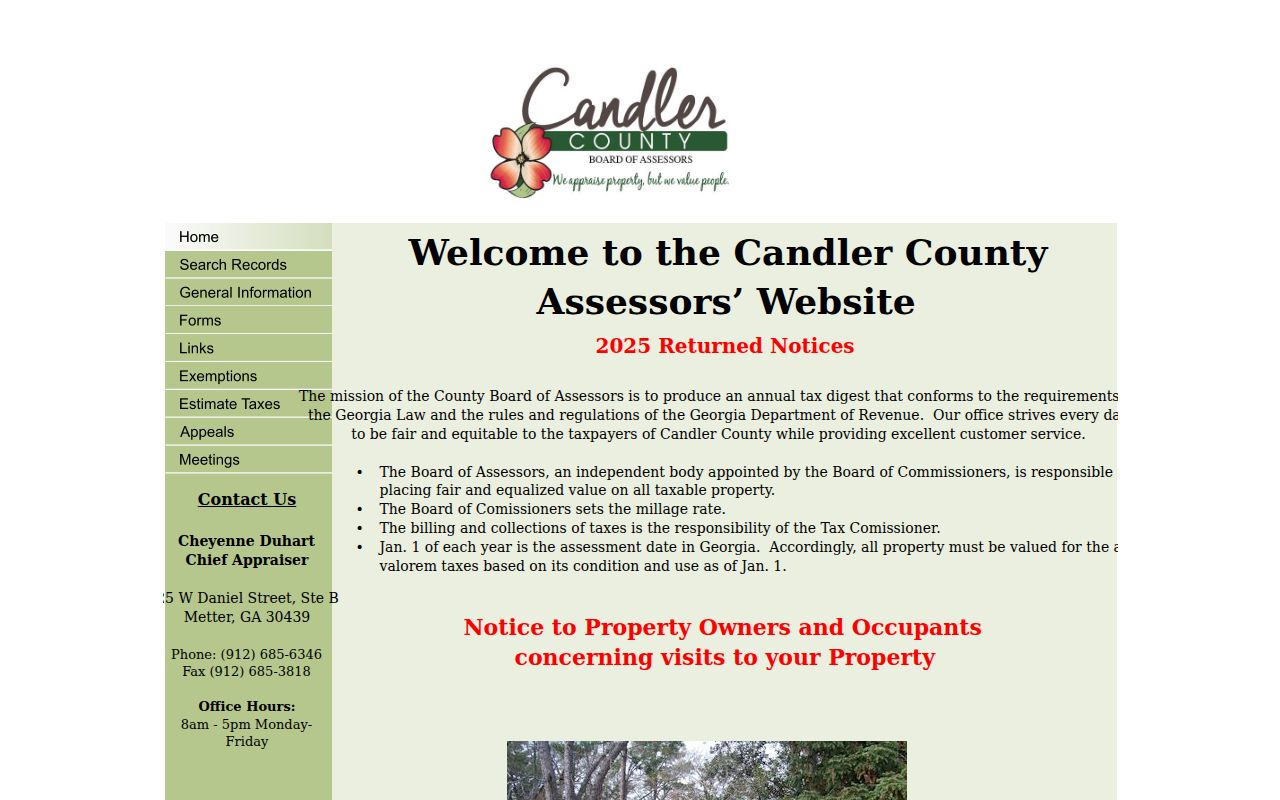
The capture shows the county source, not the value fields for any specific parcel.
Look Up a Candler County Assessed Value
Identity comes first, value second. The same street can mark a mailing address, a situs, or a road variant. A parcel number pins the right Candler County record, so match it with the legal description during any property search.
- Open the official Candler qPublic search and try the property address.
- Confirm the owner field, situs, parcel ID, and legal information before copying a value.
- Record fair market and assessment figures, exemptions, classification, and assessment year when those fields appear.
- Check the deed and sales-history context before comparing a past sale amount with the assessment.
- Assessed value
- The value produced by applying Georgia's assessment ratio to fair market value.
- Market value
- The assessor's estimate under the state's willing-buyer and willing-seller standard.
- Assessment ratio
- The relationship between assessed and fair market value, with a 40 percent Georgia baseline.
- Sale or consideration price
- A transfer figure tied to a recorded transaction, not a present appraisal.
- Reassessment
- A later valuation action that must be tied to its assessment year and notice.
A Candler County Sample Card Shows Why Codes Need a Legend
A county-hosted qPublic-style sample PDF shows an owner mailing address in Metter and a sales/history line bearing a 2024 date, a $750,000 amount, and FM/Q markers. It is a format example, nothing more. It proves nothing about current ownership or value.
The code meanings go undefined. Report them as displayed or leave them out. Never expand the initials into a sale or valuation conclusion without the official legend. The sample also shows why a sales-history amount must stay separate from the assessment figure on any Candler County property record.
Exemptions Change Taxable Candler County Value
The formula is plain. The Candler tax FAQ gives it: assessed value minus exemptions, times millage. A homestead program shifts only the taxable figure. It never rewrites fair market value. Nor does it change a recorded sale price.
Candler County lists homestead, elderly, disabled-veteran, surviving-spouse, current-use, conservation, timber, historic, brownfield, and other programs; eligibility rests with the assessor, and the Candler County property tax records guide covers the bill, deadlines, and appeals.
Candler County Farm and Timber Values May Need a Covenant Check
Georgia property-tax valuation guidance notes that current-use and conservation programs can shape taxable value, a distinction that matters on Candler County's rural agriculture and timber land. A low taxable figure is not open-market value. Check the covenant. Start at the assessment card's program or exemption field. Then check the recorded covenant in the deed records. A land-cover image alone proves nothing. If the use changes, statewide guidance warns that rollback or recapture can follow, so the exact record matters.
Manufactured Homes Can Split Candler County Property Values
Candler County treats mobile-home siting as a permitted activity. Its permit guidance applies before any unit is placed. Local tax materials handle mobile-home taxes, permits, and decals separately too. That means the deed, the structure record, the zoning approval, and the tax treatment may not all sit on one parcel card.
One figure rarely captures land and home together. Check whether the structure counts as real property or follows a personal-property path. Use the parcel ID for the land. Keep any mobile-home identifier or permit reference the responsible office lists.
A bundled sale needs the same care, so confirm what the instrument covers before matching it against the tax roll. Then compare like with like. A shared address and an aerial image do not establish a structure's tax status.
The 2026 Candler County Millage Notice Is Not a New Appraisal
Candler County posted a proposed 13.294-mill levy on August 26, 2026. The notice also lists September hearing dates. The proposed rate only affects the tax calculation. It does not revalue anything. A parcel's fair market value and assessed value stay right where they were.
Keep millage news apart from valuation records. Confirm a proposal was adopted before using it in any live tax estimate. The mailed assessment notice and the labeled qPublic fields remain the sources for a parcel's valuation year and amounts. File the notice, hearing dates, and adoption record separately. That way a proposal never masquerades as the rate that took effect.
What a Candler County Property Value Does Not Prove
An assessment is part of a public taxation system. It cannot predict a future arm's-length price. Buyers, sellers, lenders, contractors, and surveyors each examine facts the assessment never captures. That past consideration amount is one deal in time.
Value is not price. Candler County assessed value serves taxation. It is not a sale prediction, a private appraisal, or proof of what the property would bring today.
Know which type of value your decision actually needs. A Candler County tax roll figure answers assessment questions, but it cannot settle a sale price, a loan, or an estate dispute. For those matters, hire a licensed appraiser and keep the county's published figures, labeled by year, as supporting evidence.